
What a Landmark 2026 Study Means for Glucosamine Users — and How to Make an Informed Choice
If you or someone in your family takes a daily glucosamine tablet for joint pain — the kind sold as Viartril-S, Osteo Bi-Flex, or dozens of other over-the-counter brands — a major scientific study published just weeks ago deserves your immediate attention.
A team of researchers at the University of Florida has uncovered a striking association between regular glucosamine supplementation and significantly faster progression toward Alzheimer’s disease — specifically in people who are already showing early signs of memory decline. The study, published on 9 June 2026 in the prestigious journal Nature Metabolism, analyzed over 12 years of real-world health records from more than 65,000 patients. The findings have sent shockwaves through the global nutraceuticals industry.
This article breaks down what was actually found, what it means for everyday supplement users, and — crucially — what informed choices you and your health brand can make going forward.
The Headlines: What the Study Actually Found
Before we unpack the science, here are the two numbers everyone is talking about:
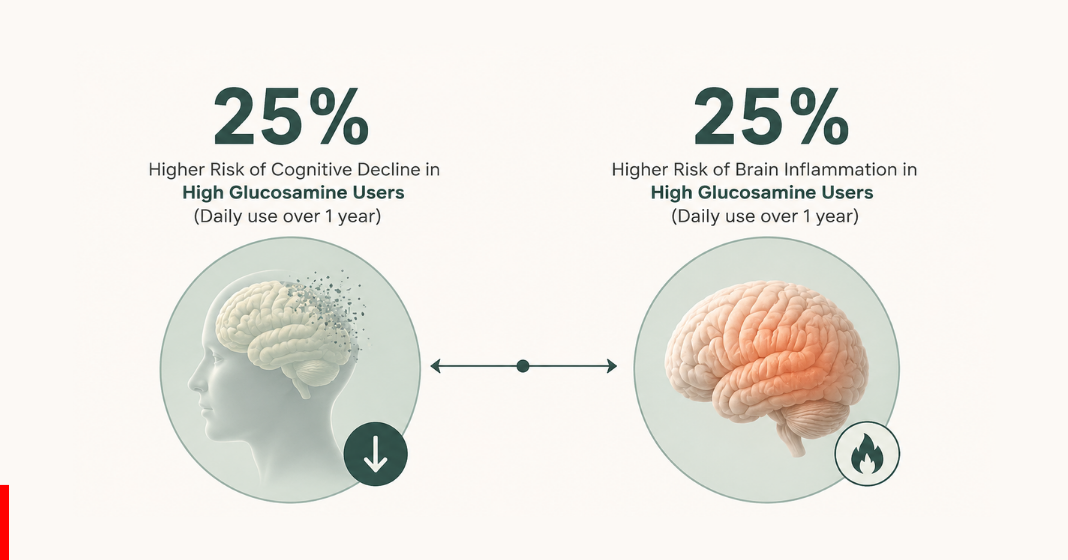
These figures emerged after researchers used artificial intelligence to comb through anonymized health records from the UF Health system, covering patients diagnosed with either Alzheimer’s Disease and Related Dementias (ADRD) or Mild Cognitive Impairment (MCI) between 2012 and 2024. The dataset included approximately 24,000 dementia patients and 41,000 MCI patients — large enough to generate statistically meaningful conclusions after controlling for age, sex, and demographics.
About 8% of both groups were taking glucosamine at the time — representing 1,896 ADRD patients and 2,750 MCI patients actively using the supplement. After rigorous statistical adjustment, the 25% higher likelihood for MCI-to-Alzheimer’s progression held firm.
The Science Behind It: Why Would Glucosamine Affect the Brain?
To understand why this matters, you need to know what is actually happening inside an Alzheimer’s brain — and why glucosamine may be adding fuel to the fire.
Normal Brain Chemistry: The Role of Sugar Tags
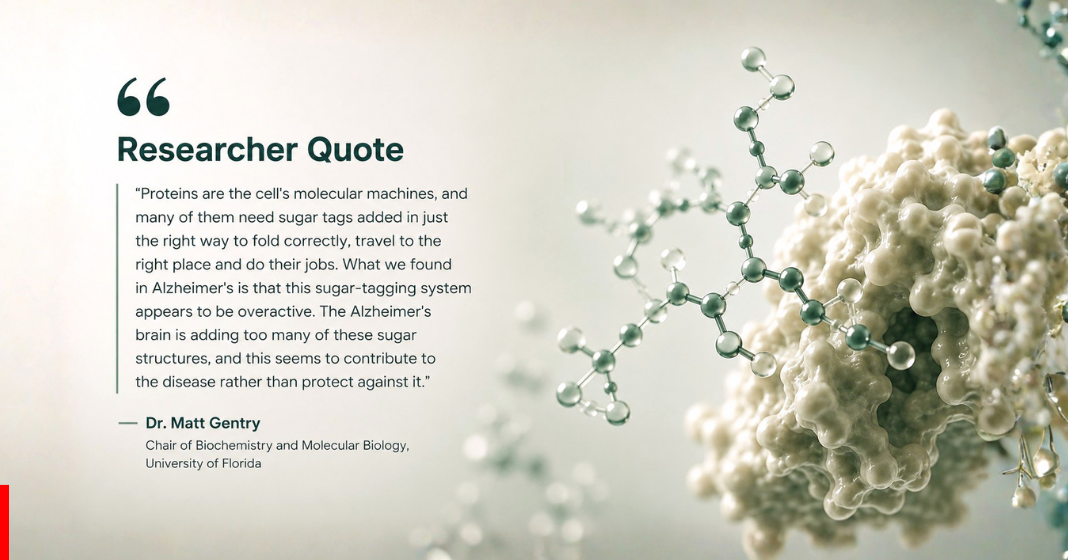
Every protein in your body — including the ones inside your brain cells — carries tiny chains of sugar molecules on its surface. These sugar structures, called N-glycans, act like an address label and instruction manual rolled into one. They help proteins fold correctly, travel to the right location in the cell, and connect with other proteins to do their job properly.
In a healthy brain, this ‘sugar-tagging’ system runs efficiently and precisely.
In Alzheimer’s Disease: The System Goes Haywire
In an Alzheimer’s brain, something goes wrong with this tagging system. It becomes overactive — proteins get tagged with far more sugar structures than they should. The scientific term for this is hyperglycosylation. These excess sugar coatings cause proteins to misfunction, which contributes to cell damage, memory loss, and disease progression. The University of Florida team, led by senior author Dr. Ramon Sun, identified hyperglycosylation as not just a side effect of Alzheimer’s, but likely a primary metabolic driver of the disease itself.
Where Glucosamine Comes In
Glucosamine is an amino sugar — a molecule composed of glucose and an amino acid. When you take it as a supplement, it does not just stay in your joints. Research confirms that glucosamine crosses the blood-brain barrier — meaning it enters the brain’s circulation directly. Once there, it feeds directly into the very same sugar-building metabolic pathway that is already overactive in an Alzheimer’s brain.
In laboratory mouse models engineered to develop Alzheimer’s-like symptoms, researchers found:
- Mice given glucosamine showed significantly worse social memory deficits
- Mice in which the enzyme producing these sugar structures was blocked (suppressed) showed improved memory
- Healthy mice given glucosamine showed no adverse effects — reinforcing that the risk appears specific to already-compromised brains
Separately, when scientists examined post-mortem human brain tissue from confirmed Alzheimer’s patients held in the UF Neuromedicine Brain and Tissue Bank, they found dramatically elevated sugar-tagging compared to healthy brains — providing direct human evidence linking this metabolic pathway to real disease.
Who Should Be Concerned — and Who Doesn’t Need to Panic
This is perhaps the most important section of this article. The study’s findings are nuanced, and context matters enormously.
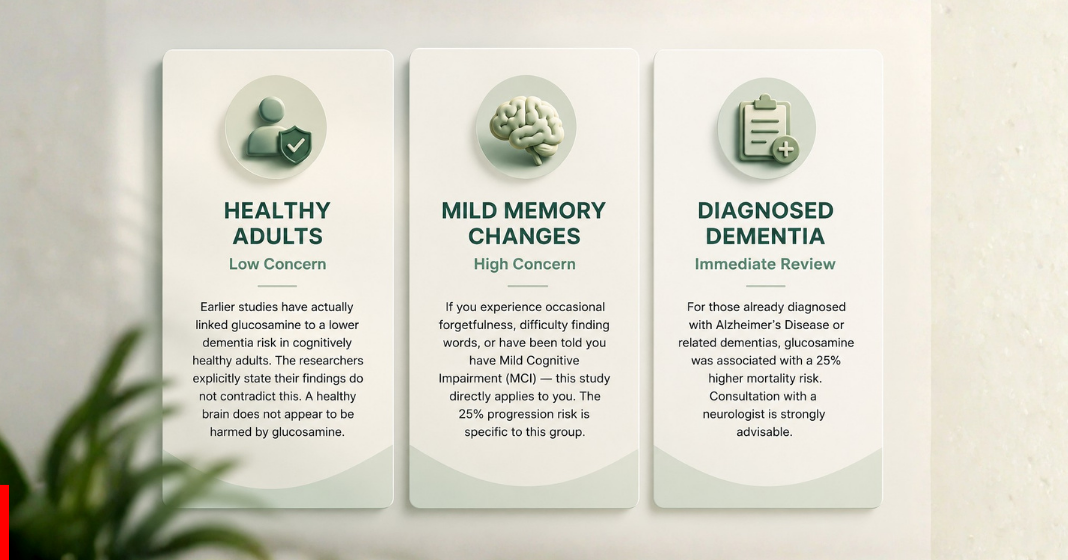
The risk is not universal. It appears highly specific to individuals whose brains are already undergoing neurodegeneration — where the sugar-tagging pathway is already disrupted and supplemental glucosamine may push that overactive system into overdrive.
That said, mild cognitive impairment is often subtle and undiagnosed. Many people experience gradual memory changes that they — and sometimes even their doctors — attribute simply to normal ageing. Given the scale of glucosamine’s user base (estimated at 40 million Americans alone, with similarly large numbers across Southeast Asia), the researchers are emphatic that clinical trials must now be prioritized.
A Billion-Dollar Category Faces a Reckoning
The global glucosamine supplement market was valued at approximately USD 3.8 billion in 2025 and projected to reach USD 6.2 billion by 2033. It is one of the most trusted and established categories in the entire nutraceuticals industry.
Glucosamine is a staple in household medicine cabinets across Malaysia, Singapore, Indonesia, and Thailand — often purchased for elderly parents or grandparents who deal with both joint discomfort and — given their age — who are statistically most likely to be experiencing early cognitive changes.
The intersection of these two realities is precisely what makes this study so significant for the Asian market. It is not uncommon for an elderly Malaysian adult to take glucosamine for their knees while simultaneously noticing increasing forgetfulness — without realising these two facts might be connected.
Other Ingredients Worth Knowing: Joint Support Options for Different Needs
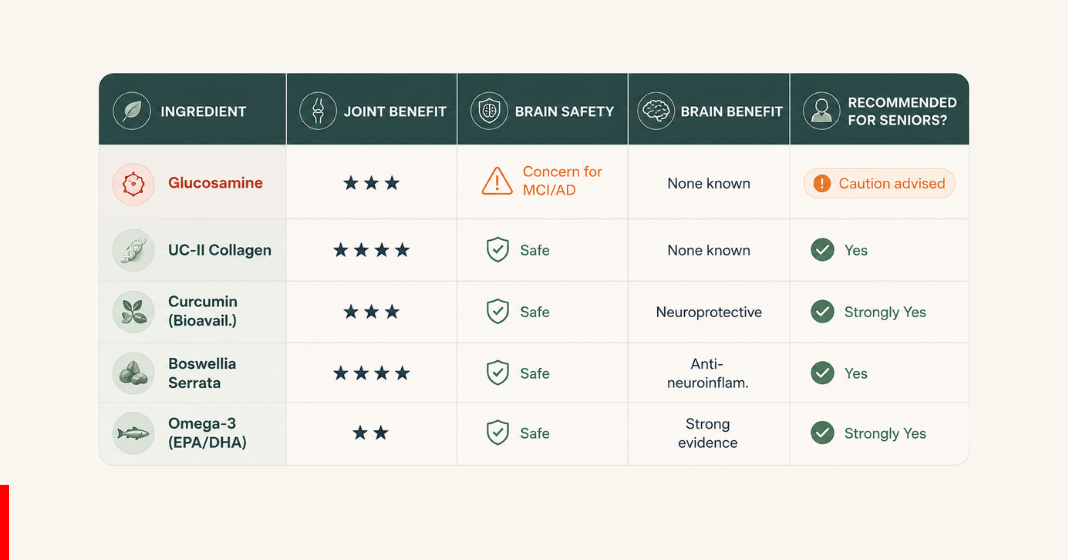
The good news is that glucosamine is not the only option for joint health. The supplement science of the past decade has produced several ingredients with strong clinical evidence for joint support — and without any known adverse relationship to brain health. In fact, some alternatives may actively support cognitive function at the same time.
1. Undenatured Type II Collagen (UC-II)
UC-II is arguably the most exciting development in joint health in two decades. Unlike hydrolysed collagen (which supplies amino acids), UC-II works through oral tolerance — tiny, intact fragments of undenatured collagen actually train the immune system to stop attacking joint cartilage. A landmark 2016 clinical trial in 191 adults with knee osteoarthritis found that UC-II at just 40 mg daily outperformed the standard combination of glucosamine 1,500 mg and chondroitin 1,200 mg by approximately 2x on WOMAC pain scores at six months.
It is derived from chicken sternum cartilage, is well tolerated, has no known interactions with neurological pathways, and is gaining significant traction in the premium joint health market globally.
2. Curcumin (Turmeric Extract)
Curcumin — the active compound in turmeric — is a natural anti-inflammatory that has been shown to match ibuprofen 1,200 mg in head-to-head trials for knee pain. But its benefits do not stop at the joints. There is a growing body of evidence suggesting curcumin has neuroprotective properties, with studies showing it can reduce neuroinflammation, inhibit the formation of amyloid plaques (the hallmark of Alzheimer’s), and support overall cognitive function.
The key is bioavailability — standard curcumin is poorly absorbed. Look for formulations using Theracurmin, C3 Complex, or BCM-95 to ensure meaningful blood levels are achieved.
For any brand reconsidering its joint health formulation strategy, a well-dosed curcumin complex offers dual benefits: joint comfort AND brain protection — a powerful positioning story in today’s brain-health-conscious market.
3. Boswellia Serrata (Indian Frankincense)
Boswellia targets the 5-LOX inflammation pathway — a different mechanism from most anti-inflammatories. A 2020 meta-analysis of seven randomised controlled trials found that Boswellia produced clinically meaningful pain reduction within as little as four weeks — faster than glucosamine. The active compound AKBA (acetyl-11-keto-beta-boswellic acid) is what drives efficacy, so branded standardised extracts such as Aflapin or AprèsFlex are preferred.
Boswellia has no known adverse neurological associations, and some preliminary research suggests it may help reduce neuroinflammation as well.
4. Omega-3 Fatty Acids (EPA & DHA)
Fish oil and krill oil are well established for their anti-inflammatory properties in both joint and cardiovascular health. More relevant to the findings discussed in this article:
Omega-3s are among the most extensively studied nutrients for brain health. DHA (docosahexaenoic acid) is a primary structural component of the brain itself. Regular omega-3 consumption has been associated in multiple large studies with reduced Alzheimer’s risk and slower cognitive decline. For any senior taking joint supplements, incorporating omega-3s is a no-brainer — literally and figuratively.
What Should You Do Right Now?
If you take glucosamine, here is a practical guide based on the current evidence:
- Assess your cognitive health honestly. Have you or a loved one noticed increased forgetfulness, difficulty with familiar tasks, or challenges with language? If yes, this study applies directly to you.
- Speak to your doctor before stopping or continuing. Do not abruptly discontinue any supplement without medical guidance, particularly if you take it alongside other medications.
- Ask your neurologist about the study. The researchers have been explicit that this requires validation through clinical trials. Your specialist may have additional context based on your specific health profile.
- Consider transitioning to a glucosamine-free joint support formula. Ingredients such as Boswellia, UC-II Collagen, curcumin, and MSM offer compelling joint benefits without the cognitive concern.
- Add omega-3s to your daily regime. Regardless of your joint supplement choices, the brain-protective benefits of high-quality EPA/DHA supplementation make it a sensible addition for anyone over 50.
- If you are cognitively healthy and have no signs of memory decline, the current evidence does not require you to panic — but it does warrant a conversation with your healthcare provider at your next appointment.
The Bigger Picture: Rethinking Supplement Safety for an Ageing Population
This study is not just about glucosamine. It is about a broader challenge facing the global supplement industry: the assumption that a product proven safe and effective for one purpose is automatically safe across all contexts and all populations.
Glucosamine is a perfectly reasonable supplement for a healthy 45-year-old managing mild knee discomfort after years of sports activity. But that same molecule, taken by a 72-year-old whose brain is already navigating the early stages of neurodegeneration, may be doing something very different.
As our population ages — across Malaysia, throughout ASEAN, and globally — the intersection of joint health and cognitive health is going to become one of the defining challenges of the supplement industry. Products formulated for joints need to be evaluated for their effects on the brain. Cognitive supplements need to consider their effects on inflammation and physical mobility. The era of siloed single-system supplementation is giving way to a more holistic, whole-body approach to healthy ageing.
The researchers at the University of Florida have opened a door with this study. Clinical trials will determine what lies on the other side. But smart brands and informed consumers do not need to wait for that definitive answer to begin making wiser choices today.
Frequently Asked Questions
Does this mean glucosamine causes Alzheimer’s disease?
No. The study found an association — not a causal relationship. Glucosamine did not cause Alzheimer’s in healthy individuals. The concern is specific to those already experiencing cognitive decline, where the supplement may accelerate an existing disease process.
Should I stop taking glucosamine immediately?
If you are cognitively healthy with no signs of memory decline, the current evidence does not mandate stopping. However, if you have MCI, early memory changes, or a dementia diagnosis, please discuss this with your doctor before continuing.
Are chondroitin supplements also a concern?
The study focused specifically on glucosamine. The researchers have noted they plan to investigate whether other supplements that the body processes similarly to glucosamine carry comparable risks — but at present, there is no published data on chondroitin’s specific effects on this pathway.
What about glucosamine in food sources?
Glucosamine occurs naturally in small amounts in shellfish and animal connective tissue. The quantities present in whole foods are significantly lower than supplemental doses (typically 1,500 mg per day) and are unlikely to raise the same concerns.
Are glucosamine-free joint supplements available in Malaysia?
Yes. A growing number of premium joint health products featuring UC-II collagen, Boswellia, curcumin, and omega-3s are available in Malaysia and across ASEAN. These formulations are increasingly available through health stores, pharmacies, and OEM manufacturers throughout the region.
Final Thoughts
The study published in Nature Metabolism on 9 June 2026 is one of the most important pieces of supplement safety research to emerge in years. It does not condemn glucosamine outright — but it does introduce a serious, evidence-backed caution that millions of supplement users deserve to understand.
The message is clear and the nuance matters: glucosamine may be fine for a healthy brain, but it may be harmful for one that is already struggling. Given how common both joint pain and early cognitive decline are in our ageing population — and how often these two conditions co-exist in the same person — this finding demands attention, conversation, and action.
Whether you are a consumer making daily health decisions, a healthcare professional advising patients, or a nutraceuticals brand thinking about your next product launch — the question to ask is no longer just “does this help my joints?” It is: “does this support my whole health?”
The science is pointing us toward better answers. The brands and individuals who respond thoughtfully — with curiosity, caution, and a commitment to whole-health thinking — will be better positioned than those who simply wait for the next headline.

Looking to Reformulate Your Joint Health Line?
Sky Nutraceuticals Sdn Bhd is Malaysia’s trusted GMP & Halal-certified OEM manufacturer for nutraceuticals, dietary supplements, and functional food. We help health brands across ASEAN formulate smarter, safer, and more effective products — from concept to certified shelf-ready product.
References & Sources
- Hawkinson, T.R., Gentry, M.S. & Sun, R.C. et al. (2026). Hyperglycosylation is a metabolic driver of Alzheimer’s disease. Nature Metabolism. DOI: 10.1038/s42255-026-01538-4
- UF Health. (2026, June 10). Popular joint supplement glucosamine linked to faster Alzheimer’s progression. ScienceDaily.
- Sun, R. (2026, June 13). Glucosamine supplements may speed memory loss from Alzheimer’s. The Conversation / MedicalXpress.
- (2026, June 14). A Supplement For Joint Pain Could Accelerate Alzheimer’s Memory Loss.
- (2026, June 11). Popular Supplement Linked to Faster Alzheimer’s Progression.
- Lugo, J.P. et al. (2016). Efficacy and tolerability of UC-II in modulating knee OA symptoms. Nutrition Journal.
- Xu, Q. et al. (2025). Curcumin and multiple health outcomes: critical umbrella review. Frontiers in Pharmacology.
- Arthritis Foundation. (2024). 12 Supplements for Osteoarthritis.
- Nutraceutical Business Review. (2026, June). Glucosamine linked to 25% faster Alzheimer’s progression in major new study.